
What Are Options?
You’ve been investing for years. You know how stocks work. But every time someone mentions “options,” your eyes glaze over — it sounds complicated, risky, like something day traders do while staring at six monitors.
Here’s the thing: options are not inherently complicated or risky. They’re just a different kind of financial tool, and like any tool they can be used recklessly or responsibly. Let’s start from scratch.
The Basic Idea: A Contract, Not a Stock
Section titled “The Basic Idea: A Contract, Not a Stock”When you buy a share of Apple, you own a tiny piece of Apple. Simple enough.
An option is different. It’s a contract between two people — a buyer and a seller — that gives one of them the right (but not the obligation) to buy or sell a stock at a specific price before a specific date.
That’s the whole concept. Everything else is details.
The House Analogy
Section titled “The House Analogy”Imagine you’re eyeing a house listed at $400,000. You’re interested but not ready to commit. So you go to the homeowner and say, “I’ll pay you $5,000 right now for the right to buy your house at $400,000 any time in the next 90 days.”
The homeowner thinks about it. If you exercise that right, they sell at a price they’re apparently okay with. And they keep your $5,000 regardless. So they agree.
Now you have an option — specifically a call option — on that house.
Three scenarios could play out:
-
The house jumps to $450,000. You exercise your right to buy at $400,000 and instantly have a home worth $50,000 more than you paid. Minus the $5,000 contract cost, you’re up $45,000.
-
The house drops to $350,000. You’d be crazy to buy at $400,000 when it’s only worth $350,000. You let the contract expire. You’re out $5,000, but that’s all you lose.
-
The house stays around $400,000. No advantage to exercising. It expires, you’re out $5,000, and life goes on.
Notice something important: the homeowner kept your $5,000 in every single scenario. That $5,000 is called the premium, and the person who sold you the option keeps it no matter what.
Hold that thought. It becomes very important later.
graph TD
  H["You pay $5,000 for the right to buy at $400K"]
  H --> U{"House value?"}
  U -->|"Jumps to $450K"| W["Exercise: Buy at $400K\nProfit: $45K"]
  U -->|"Drops to $350K"| L["Don't exercise\nLose: $5K premium"]
  U -->|"Stays at ~$400K"| N["Don't exercise\nLose: $5K premium"]
  W --> S["Seller kept $5K either way"]
  L --> S
  N --> S
  style W fill:#22c55e,color:#fff
  style L fill:#ef4444,color:#fff
  style N fill:#eab308,color:#fff
  style S fill:#3b82f6,color:#fff
Calls and Puts: Two Flavors
Section titled “Calls and Puts: Two Flavors”There are exactly two types of options:
Call Options
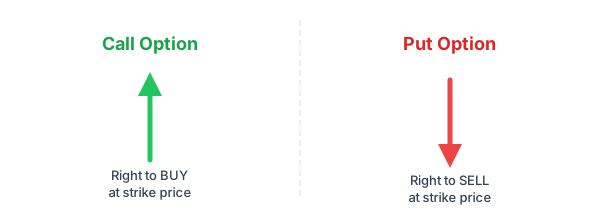
Section titled “Call Options”A call option gives the buyer the right to buy a stock at a set price. The house example above was a call option. If you think a stock is going up, buying a call lets you profit from that move without owning the stock yet.
Put Options
Section titled “Put Options”A put option gives the buyer the right to sell a stock at a set price.
Think of it like insurance on your house. You pay a premium to the insurance company. If your house burns down, you can “sell” it for the insured amount. If nothing happens, your premium is gone but you didn’t need it. Puts work the same way — if you own shares and worry about a downturn, a put lets you sell at a predetermined price even if the market drops below it.
What’s Next
Section titled “What’s Next”Ready for the vocabulary? Strike prices, expiration dates, and what “in the money” means are all simpler than they sound. Head to Options Terminology.
Every trade has two sides — a buyer and a seller. The seller’s side is where the income is. Learn more in Buyers vs. Sellers.